
How does electrical safety work in the server room?
Bender technology stands for electrical safety. The success story of the family business began with the invention of the first insulation monitoring device 75 years ago. Today, Bender operates internationally and is the market leader for electrical safety products, including electrical safety products. a. for systems and solutions in the medical sector, in the transport sector and in electromobility. Our colleague Irene wanted to know more and asked Peter Eckert, Market Segment Manager Critical Infrastructure at Bender GmbH & Co. KG, for an interview.
You have been working in the field of data center (data center), secure power supply for over 20 years. What is your current position?
I originally come from communication and radio technology. I am currently working in market segment management for data center applications at Bender, where my focus is on the electrical safety and availability of data centers.
What do Bender and EPS have in common?
High availability is our common theme. Bender has been active on the market for 75 years, initially in the coal and mining sectors, and today the spectrum ranges from measurement, protection and monitoring systems to mechanical engineering, plant engineering, electromobility, energy generation and distribution. Thanks to our measurement technology and the permanent monitoring of safety-relevant circuits for fault, differential and operating currents, failures in the power supply can be detected at an early stage and, if necessary, corrected. be avoided by this.
Can I help you?
This brings us to the main topic of our interview, residual current measurement. How can this technology be explained in simple terms?
In technical terms, the “residual current … the difference between the current flowing in the outer conductor (L) and the current flowing in the neutral conductor (N).” A basic principle in electrical engineering states that in a faultless grid, the incoming current must be as strong as the current that flows out (direct current). If a fault occurs, e.g. in the insulation, and the current does not flow over the line, but over the body or the earth, a residual current is created. We all know this from our household: If the residual current circuit breaker (RCD) “jumps”, it is either a fault in the circuit or just an excessive, short-term inrush current (or transient), and the current fails. In Data centers want to avoid this situation as much as possible, but it is almost impossible to completely shut down the power as in private homes. In the server room, the devices for residual current measurement monitor the entire system and provide an overview of the availability of the electrical system (condition monitoring).
If I understand you correctly, a device for residual current monitoring is similar to the RCD in our homes. But what does residual current or Residual current monitoring exactly?
The task of a residual current monitor (RCM) is to monitor an electrical installation for the nature of the electrical insulation, deterioration (e.g. aging) or connection faults (PE and N conductors reversed) and to trigger an acoustic alarm if the residual current exceeds a certain value (DIN EN 62020 (VDE 0663) : 2005-11).
How is residual current calculated?
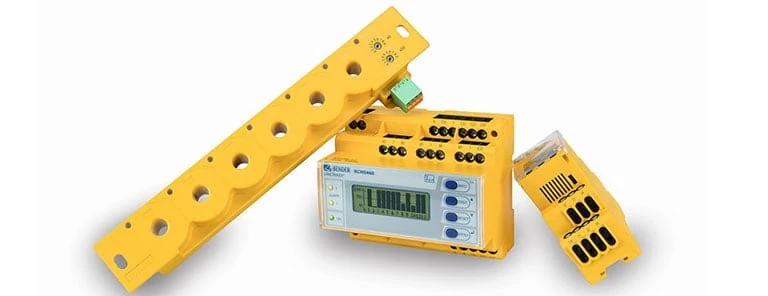
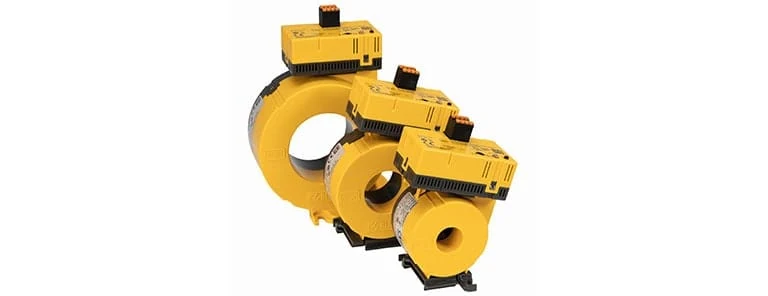
Residual currents are most easily measured by all-current-sensitive sum current transformers (type B), such as those used in residual current devices (RCDs) or residual current monitoring devices (RCMs).
However, a distinction must be made between the frequency range that the measuring device is capable of measuring. Simple devices (type A), for example, only measure in the 50Hz range, and are therefore not able to measure high-frequency or DC currents (DC – direct current). This can be the result, or reduce the significance.
What other forms of measurement are there?
Power measurement (current) Voltage and frequency measurement.
Where is residual current measurement used?
This is easiest where the topics of fire protection (300mA) and personal protection (30mA) are required and a simple shutdown of the system for maintenance purposes is not possible without great effort (keyword insulation measurement as part of the periodic inspection), in industrial environments without a self-triggering protective device or wherever it is difficult or cumbersome to switch off electricity. The causes of errors in the data center are more at the device level, but dangers can also develop via the cabling , for example, if mechanical influences stress the cables or dangerous fumes are generated in open terrain and this has an influence on the insulation of the cables. Permanent monitoring is essential here. Retrofitting is possible, but involves more effort.
Residual current monitoring
Why is residual current measurement used in the data center?
The most important reasons are:
- Residual current measurement ensures operation for man and machine as standard-compliant operation without RCD (“RCD”).
- The EN50600 requires uninterrupted maintenance from availability class 3 and this technology enables the operator of the plant to have a safe solution for measuring without shutting down and thus uninterrupted operation.
- It means that the technical condition (constantly monitored) must be fulfilled as the basis for the risk assessment to adjust the inspection periods.
- Faults are located quickly: Rapid fault localisation minimises the downtime phase and increases availability.
Why is residual current measurement in server rooms so important?
Safety for man and machine on the one hand and constant availability on the other require a technology that provides the best possible protection with as little shutdown or shutdown as possible. maintenance. The RCM technology enables early detection of faults and allows the plannable elimination of faults, if necessary during operation. In addition, constant monitoring replaces selective testing. A 24/7 overview of the facility is possible.
This measurement is also important from the point of view of the standards …
Exactly. The EN50600 requires, for example, uninterrupted maintenance for availability classes VK3 and VK4. This is supported by the RCM technology or enables. We need a TN-S system (abbreviation for French terre neutre séparé, separate neutral earth) with a central grounding point. A concrete example: If someone connects a device, e.g. a recirculation unit, incorrectly, the electricity begins to spread undefined in the building. In the short term, this won’t mean anything, but in the long term, bugs will be reported. Here, a permanent measurement helps to identify the location of the fault very quickly. A nice tool for high availability 😊.
What are the advantages of residual current measurement?
In the case of residual current monitoring, residual and residual currents are reported before the system has to be switched off in the event of a fault. Shutdowns, even for a short time, are a thing of the past thanks to the targeted use of residual current monitoring systems. The availability of an electrical system is increased and the cost of retesting electrical systems and equipment is minimized. With partners like EPS, you have a trained team that helps you to take the right measures. It is important to see the residual current measurement as a tool and not as a static system.
To what extent does residual current contribute to the safety of plants and human lives?
The measurement alone does not secure lives, it is always important to implement a process that shows and prescribes how to proceed in the event of a malfunction or failure. warning. The main advantages are:
- Preventive safety to protect people from electrical current hazards
- Minimization of disruptions and unexpected interruptions to the operation of sensitive facilities
- Immediate detection of insulation faults in newly installed equipment and equipment
- Monitoring of TN-S systems on additionally unwanted N-PE bridges
- Greater fire safety: Residual currents are detected as early as the development phase. An overload of N-conductors is detected and fire hazards in electrical systems are thus reduced.
What role does residual current measurement play in UPS systems, in server rooms, in emergency power generators, in data cabling?
In addition to the above-mentioned advantages, RCM measurement also gives operators a way to monitor the condition of the systems and pipes. Faults from the systems or the cabling are detected (keyword EMC).
What added value does the customer have through the use of residual current metering devices?
He is thus acquiring a system with a wide range of benefits in terms of security and availability.
To what extent does residual current measurement contribute to the high availability of the power supply?
By identifying faults or faults at an early stage, the operator can act at an early stage and, if necessary, take action. implement measures without disrupting operations.
Would you like to add anything else about our topic or the EPS company?
EPS dealt with this topic at an early stage and recognized the potential. Residual current measurement is already being implemented in some projects.
Thank you very much!