
Availability in the server room: Data center standard EN50600
Our colleague Peter Reisinger has broad experience in the planning and management of data center projects (data center projects). In our interview, he shares his insights on what needs to be paid special attention to in terms of planning and safety during the initial discussions with customers. In doing so, he emphasizes not only the importance of the individual phases, but also of the technical realization.
Jürgen Grubmüller, our technical manager, explains the topic of battery management to us with his know-how.
Peter, what can you tell us about your experience with data center projects? What role does the size of a server room play?
Peter: The size of the premises plays very little role in terms of security and availability. It is more important to take into account and ensure the customer’s specific requirements.
The heart of server room planning is to analyze the necessary availability requirements and future data center performance after the business, event and risk analysis.
Once this is determined, the design and planning phase begins according to the current norms and standards of the EN50600. Since 2013, this standard has provided guidance in the classification of system availability in data centers in Europe. It defines the basic requirements for the physical infrastructure of data centers, including energy supply, air conditioning and security technology.
The standard considers 4 availability classes: Class 1 offers the lowest availability and Class 4 the highest. Another focus here is to increase the efficiency of server rooms and to achieve a conscious use of energy.
This also results in the necessary area of the server room infrastructure.
For smaller applications, our rack data center mini data centers or edge data centers. It is important that economic proportionality to the improvements that can be achieved is taken into account.
In order to use the content and the high standards of the EN50600 in part internationally, there are already initial considerations and approaches to integrate them into the international standard ISO / IEC 22237.
What data center solutions does EPS offer?
Peter: We plan and build turnkey complete data center solutions.
Depending on the requirements, there are various options such as in-house data centers or modular data center outdoor containers. Care is taken to ensure that the entire data center area, consisting of IT and technical areas, is housed in separate fire compartments.
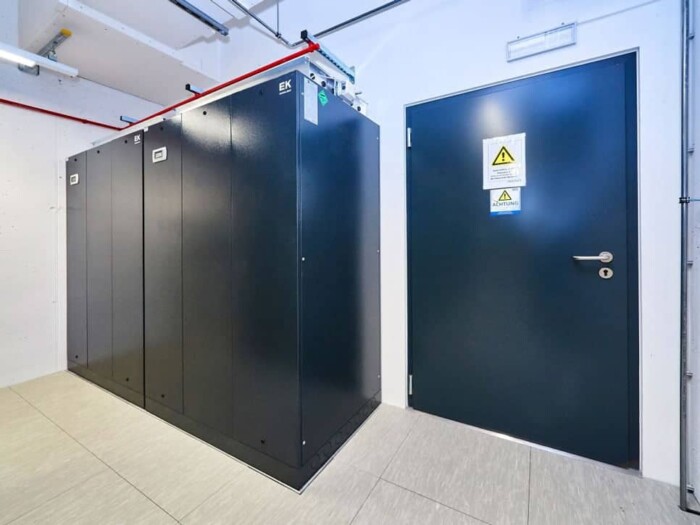
For smaller space requirements, we recommend our compact and scalable rack data center mini data centers. These consist of one or more rack combinations including UPS power supply including power distribution with external bypass circuit, as well as in-rack air conditioning and fire extinguishing systems. The trend towards “rent instead of buy” with our managed service package is clearly recognizable. The customer benefit is that we offer 24*7 monitoring, including alerting and maintenance of the data center infrastructure, at a fixed monthly price. This allows the customer to concentrate on his core tasks.
Increasing energy efficiency is a key word in data centers. Can they be measured?
Peter: Energy-efficient operation and energy efficiency targets are indispensable in a data center. Therefore, the quality, energy consumption and energy flows must be permanently measured and analysed and, if necessary, reported.
DIN EN50600 defines three levels of granularity. These specify where and how exactly measurements are taken. This applies to the data center power supply and data center air conditioning systems. In this context, a constant increase in the efficiency of the overall solution should be strived for and achieved. In data center cooling, the greatest potential is to save energy. When it comes to room conditioning of the server room, we rely on cold generation with free cooling. The cold air supply to the IT equipment is provided by our RCS server racks. Thus, targeted and adjustable heat dissipation takes place. In doing so, we rely on CO2-neutral, HFC (partially fluorinated hydrocarbons)-free refrigerants, respectively. Water (R718) or propane (R290) as real nature-friendly alternatives. As a result, these refrigerants do not fall under the F-Gas Regulation, and future operational safety is guaranteed.
I keep reading the abbreviation PUE. What does it stand for?
Peter: The PUE value stands for Power Usage Effectiveness. This is the value that assesses the efficiency of a server room holistically. The total energy required by a server room (total facility power) is compared in relation to the energy consumption of the servers (IT Equipment Power Consumption). If the value shows 1 or 1.5, it is called an energy-efficient server room. If possible, renewable energy should also be used.
Uninterruptible power supply is one of EPS’s core businesses – which systems guarantee an uninterruptible power supply?
Peter: In a data center, the electricity must be available 24*7 without interruption. The smallest network problems could cause failures or data loss. To prevent this, we use scalable and modular UPS systems with stationary battery systems (pure lead or Li-ion batteries) that guarantee an uninterruptible power supply. Furthermore, we pay attention to a multi-path A+B system, i.e. each of the redundant server power supplies is protected with a UPS path. When housing the battery system, we pay attention to the current requirements of DIN EN IEC 62485-2.
Jürgen, what can you recommend to readers on the subject of batteries? Can you share any tips and tricks?
Jürgen: Unfortunately, I can’t offer tips and tricks in the computer center. Only facts and figures 😊 apply here. We proceed in accordance with the DIN EN 62485-1 standard, which regulates the accommodation and operation of batteries. According to this, batteries are set up in their own room and in their own sections, and their temperature is checked regularly. The ventilation, the temperature of the batteries, the cell voltage, the separation functions of batteries and switches, the distance to the ground, also play a role. Individual batteries must be monitored preventively, because defective batteries are known to be one of the biggest causes of fire.
What does standard-compliant storage of batteries look like?
Jürgen: The DIN EN 62485-1 standard requires that the batteries always be placed in their own fire compartment when converting or modernizing a data center. EI90 walls, equipped with early fire detection and individual monitoring, further increase safety. The number of loads to be bridged is decisive because appropriate battery cells must be available.
How do you protect server rooms from fire, air, dust or water?
Jürgen: The best way to set up the power supply is with an A/B fail-safe multi-path power supply system in your own rooms. Low-voltage distributions in separate fire compartments are also necessary. Tight doors provide additional protection against dust and fumes, and high-quality bulkheads must be properly covered. The modular construction technology has proven to be very successful. In the case of conversions, the evaluation of existing water, gas or electricity lines must be carried out. Built-in leak warning systems sound the alarm in good time if a leak occurs.
Apart from the UPS, what is part of a secure power supply?
Jürgen:
The basis of every available power supply of a data center is the interface to the energy supplier. If possible, we recommend a multi-thread supply provided by two separate transformers. Care must be taken to ensure that the cable routes and the building entry are carried out separately. It is also important that the two supply lines do not run in the same fire compartments.
The UPS system plays a very important role in the safety power supply. It protects in the event of short-term power outages or Power quality issues. For longer power outages, an emergency power system (NEA) offers secure supply protection. With internal and external tank systems, a secure power supply can be guaranteed for several days in an emergency.
How do you assess the future of the server room?
Peter: Cloud solutions, infrastructure-as-a-service and the outsourcing of services to external data centers will certainly play an important role. However, I am convinced that hybrid solutions, company-owned server rooms or edge solutions will continue to be important in the future. Particularly important data will remain on site, i.e. in the company.
The Corona pandemic in particular has shown us how important it is to have access to essential data and hardware anytime and anywhere.
The digitalization of business processes (Industry 4.0) as well as trends such as IoT, AI and big data will continue to drive the demand for high-availability server rooms.
How can data centers contribute to the energy transition?
Jürgen:
Air conditioning of server rooms is a very important aspect when it comes to energy efficiency and cost savings. A free cooling system offers high savings potential. The technology uses the outside air, up to a certain outside temperature, for cooling and does not require energy-intensive compressors.
It is advisable to supply server rooms with the help of renewable energies, for example through the use of PV solar systems.
Although these systems alone cannot ensure an uninterruptible power supply, they help to sustainably reduce and cover the energy supplier’s electricity consumption.
Peter and Jürgen, thank you very much for your time!
Can I help you?
Can I help you?