

Immersion-Cooled Data Center Monitoring
What distinguishes immersion cooling from other cooling methods?
In immersion cooling, the liquid is not led to the chip, but the entire server (or several servers) is immersed in an immersion bath of dielectric, i.e. non-conductive, liquid. The liquid absorbs the heat from the hardware directly, circulates through a cooling circuit, releases the heat and is reused. The process is used where high-density racks require extreme cooling performance – for example, in data centers for AI and ML (machine learning) applications.
What areas does leak detection need to cover?
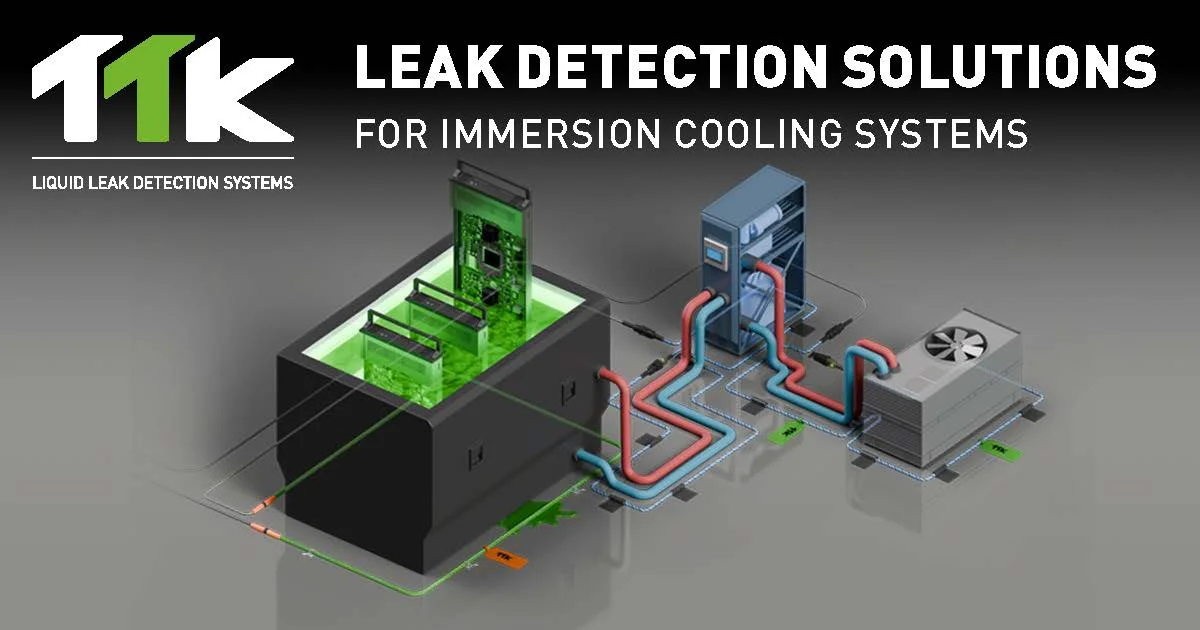
Unlike individual cooling pipes, the cooling system in immersion cooling includes several components:
- Tank: the container with the immersed hardware.
- CDU (Cooling Distribution Unit): distributes and controls the fluid cycle.
- Pumps and cooling towers: keep the circuit moving and dissipate heat.
- Piping: connect the components to each other.
TTK sensor cables are designed for both conductive and non-conductive liquids and cover these four areas throughout.
How quickly can a leak be located?
The sensor cables not only report that there is a leak, but also where. Connected to an alarm control panel (e.g. FG-NET or FG-ALS4-OD), the message can be forwarded directly to the responsible office – a prerequisite for a short response time instead of subsequent troubleshooting throughout the immersion bath.
Why is it worthwhile to integrate it into server room planning?
Immersion cooling systems are usually newly planned or retrofitted in the course of an expansion. If leakage detection is taken into account from the outset, it can be neatly integrated into cable routes, alarming and existing building technology instead of being added later.
Are you planning an immersion-cooled data center or retrofitting an existing system? We support you in the selection and integration of the right leakage detection. Contact us!